Showing posts with label Society. Show all posts

Wednesday, 21 March 2012

How to Build a Brilliant Team


Build a Brilliant Team

An innovative idea may inspire a new business, but it takes brilliant people to make that business a success. Michael Crom, executive vice president and chief learning officer of Dale Carnegie Training and co-author of The Leader in You: How to Win Friends, Influence People and Succeed in a Changing World, discusses the first step to startup success: assembling your team. Read on for Crom's advice on finding the best people and filling leadership roles--while still saving some cash. 
 
What's the most important position to fill at the outset?

No. 1, you need to assess your own competencies. As the founder, you really should have a very strong vision and clear goals for the company. If you're not able to meet that need, that may be the very first thing you have to fill in terms of leadership roles. You need to look at creating a competency map of what you need for your own company: Very often for startups, fundraising and relationship-building are going to be key. Selling skills, project and management skills--those are ones that come to my mind instantly.

What personality traits should entrepreneurs look for?

It's important to look for people who are real go-getters and are passionate about the goals you have for the company. Also, look for people who have past work experience that's relevant to what you're doing, particularly people who have worked in small companies, because they aren't used to having to worry about other people doing things for them. They're not used to worrying about corporate rules and regulations, which you may not have in a startup, so they can be more independent in their ability to do things, and they don't mind crossing over barriers and doing multiple tasks. Experience in a large company can be valuable, but save those hires for when you're beyond the initial startup phase.

Where can valuable team members be found?

New business owners tend to really love what they're doing and are so excited by it, they live with gusto. That enthusiasm will actually begin to attract people to your team and attract people who want to help--that's a great starting point. You also need to take some time to be active in your community. I even encourage you to do something for people who can do nothing for you; you'll be surprised by how many fellow business owners are attracted to that. Volunteering is a great way to get out and meet people to expand your network. In lieu of that, there are some great social networking resources online: LinkedIn and Facebook, for example, are tremendous tools to help find people with talent.

Do you have any tips for adding staff when the budget's tight?

A board of advisors may be the way to do that. By looking at your own social network, you can often find people who just enjoy being around the excitement of a startup entrepreneur. Look for a diversity of backgrounds when assembling your board of advi-sors; you might look for someone who has a financial background, someone who is a great marketer, a person who is strong on business context, etc.
Your first hires should be people who are different from you. The other thing that I would look for in my first group of hires, or the people who are going to help out at the onset, are people with multiple talents.

This article was originally published in the March 2012 print edition of Entrepreneur's StartUps with the headline: Build a Brilliant Team.

Sunday, 26 February 2012

A good sign of vision is that no one else can see it

by Saul Colt  |  October 6/2011  |  

Most of the world heard the news of Steve Jobs passing yesterday and as expected when someone as beloved and historically significant as Mr. Jobs passes there will be tributes. Instead of repeating what hundreds have already said I would like to offer a different take and actually attempt to describe what made Mr. Jobs different by not talking about him at all but rather to share an experience I had recently.
A few weeks ago I had the opportunity to hear Jelly Helm speak. For those not familiar, Jelly Helm is formerly Executive Creative Director of Wieden+Kennedy in Portland and Amsterdam, and Founder/Director of W+K 12, Wieden+Kennedy’s experimental in-house school. I speak at a lot of conferences and am exposed to a lot of great people so I am a little jaded but knew right away that this talk was going to be different.

For starters, Jelly didn’t speak to the crowd, he welcomed us into his mind and explained Branding and Storytelling with a “Show, Don’t Tell” point of view [side note: Show, Don’t tell will be the name of my Marketing book if I ever find the time to write it] and introduced concepts and ideas that on first glance were probably out of the norm but upon further thought made perfect sense.

Jelly introduced the concept of how some of us see a tragic gap between the world as we know it and the place we know it could be. He referenced Parker Palmer by calling it a tension between corrosive cynicism and irrelevant optimism (a place of no shadows) and stated that this is really a creative tension and where the growth actually occurs.

Think about that for a second. Everything has two sides and needs a little of both to be great.
The other thing that every great idea/company needs is the following:
  • Vision: What you see
  • Purpose: What you do different, do it
  • Presence: Let people see purpose by what you do – present expression, the experience of you
  • Roots: What do you come from, how you see the world, pull everything into your story. Deep roots are fed by a vision
Have you ever asked yourself what’s your deep story that connects vision to roots?
If you can answer that question and have a real passion for something, I, Jelly and Steve would tell you to follow your passion because very few people get to say that they are doing what they really love.
I never had the chance to meet Steve Jobs but I was certainly touched by his vision. Jelly reminds me a lot of Steve Jobs because of the way they both look at the world and see an opening to really impact it for future people.

I recently read Buckminster Fuller say before his passing that he has no feeling about death because while there will soon be a time when no one can see him anymore, his stories and the emotions of his experiences won’t leave people and can’t be erased.

I feel that way about Steve Jobs and I am grateful that Jelly Helm reminded me of this.

Photograph from Louis Tremblay

Sunday, 19 February 2012

EIGHT THINGS YOU MUST DO WHEN SELLING A PIECE OF ART:

There are a few steps to take when you’ve made a sale of your artwork.  The most important is to make a meaningful connection with your new collector.  After all, the collectors are your supporters who enable you to live a creative life.  And living a creative life enables you to make important contributions to the world.
The rest of the Eight Things You Must Do are necessary for all creative professionals for their creative success.

1.)  PHOTOGRAPH OR SCAN YOUR ART:  Before selling any and every piece you create, be sure to have a photograph of it, preferably a high quality scan.  Trust me, this will come in handy later for more reasons than I can list here.

2.)  AGREE TO A PRICE: The price of your artwork should already be determined and listed, either on your website or on the price sheet if you’re at an art festival or event.  A customer may ask for a discount.  It’s up to you if you want to offer a discount. Some artists will bump their prices up by 5%, then give a discount of 5% when asked.  Or, if a customer is buying multiple pieces, you may want to give a small price break.

3.)  ADD SALES TAX AND SHIPPING CHARGES:  In Orange County, California, our sales tax is a whopping 8.75%!  That gets added to the price of the piece, as well as my estimated shipping charges, if the item will be shipped.  Be careful with estimating shipping – sometimes you’ll end up paying a lot more because you didn’t charge enough.  (Note:  If you are shipping the item to an out-of-state location, you don’t have to charge sales tax.)

4.)  ARRANGE DELIVERY:  There are a few options for artwork delivery:
  • CUSTOMER TAKES IT HOME ON THE SPOT:  When at an event, if the customer paid cash or credit card (and you processed the card already), then let them take it with them if possible.  This will save you the trouble of shipping later, and the customer is usually happy not to have to pay shipping charges.
  • If they paid by check or PayPal, I strongly advise you to wait for the payment to clear. We’ve sold many art pieces at shows where the customer paid by check, and only one time did a check bounce.  But I’ll tell you, that one time stung!  I no longer let the customer take the item home until after the money is officially in the bank.
  • PICK UP AT STUDIO:  If the buyer is local to your area, arrange for them to pick up the piece at your studio after the payment has cleared.   I love when people come to our Drew Brophy studio to pick up art, because it’s an opportunity to show them other pieces. Once we get a new collector to come into our studio and get to know us personally, they become a Drew Brophy fan for life.  The personal connection is very powerful.
  • DELIVER AND HANG FOR THEM:  You could offer to deliver and hang the art for a small additional fee that would cover your time and travel expenses.  If a customer purchases several large pieces, and they are less than a two hour drive from our studio, we offer to personally deliver and hang the art for them at no charge.
  • FOLLOW UP:  If you’ve shipped the piece, follow up by phone or e-mail later, to make sure that it arrived safely.
5.)  PROVIDE A RECEIPT: Print out a receipt for the customer so that they have a record of the artwork and price they paid for it.  The receipt should have all of your contact information on it, as well as your website address, your phone number and your email.  Many artists include a copyright notice on their receipts.  Ours states that “The artwork copyright is owned by Drew Brophy.  Any reproduction of this artwork must be agreed to, in a separate licensing agreement and in writing, by Drew Brophy.”

6.)  RECORD THE COLLECTORS CONTACT INFO: Always keep a record of all buyers of your artwork. We have a spreadsheet of every person who has bought Drew Brophy’s originals going back to 1996 (which is when we started keeping track).  I recommend using an Excel Spreadsheet so that you can sort according to year, or painting name, or medium, as you need to.  The spreadsheet has the following information:

TITLE OF ARTWORK/Year Created/MEDIUM/Size/$ PRICE PAID/Buyer NAME, ADDRESS, PHONE, EMAIL

7.)  SEND A THANK YOU CARD:  We mail a nice “thank you” card about a week after the painting was shipped, delivered or picked up.  In the card we write our heartfelt thanks for the buyer contributing to the arts and we share our wish that they enjoy the art for years to come.

8.)  MAILING LIST:  Add your collector’s information to your mailing list (ask permission to add their e-mail to your newsletter list).  If you don’t send out mailers or newsletters, eventually you will, so start your list now.  A mailing list is a fabulous way to keep in touch with your collectors over the years, particularly if you want to invite them to future shows or let them know about new works that you’ve created.

Be sure to let your collector know that you appreciate their love of your art, and that you are happy to see the piece go to a good home.  Without the support of our collectors, I don’t know what Drew and I would be doing for a living.

Art collectors are the angels that provide support for the arts and that make it possible for artists to put more beauty into the world. For that, I’m grateful!

article from Maria Brophy

Money is a Commitment - Art, Lifestyle, Inspiration

Money is a Commitment


Until one is committed, there is hesitancy, the chance to draw back, always ineffectiveness….the moment one definitely commits himself, the providence moves, too.”  William Hutchinson Murray

Article by Maria Brophy

Money is the physical manifestation of a promise to do something in the near future.

You prove your commitment when you put your money down.
Once the money is paid, you are well on your way to the end result.
On the other side of the fence, your clients are committed when they put their money down.
ON TRAVEL:  Remember that last plane ticket you bought?  You knew it was non-refundable; there was no turning back.

The moment your pulled out your Visa card and made the payment, your mind went to where you were going to be.  For me it was Hawaii.   The day I bought our plane tickets to the North Shore, I was already surfing Puaena Point in my mind!  I was there before I was actually there.
ON BUSINESS:  Some people call me hardnosed, and heck, I’ve been called worse!  But when it comes to business, I’m very serious about keeping my little venture running.  And so, I have to weed out the committed from the bullshooters.

Often we have people come into our lives that promise us the moon (and lots of money), but don’t deliver.  Many years ago we figured out a great way to make the bull-shooters disappear and the serious stay.  (And it prevented us from ever getting ripped off again.)

Drew and I instituted a policy that requires a client to pay 50% up front (or an advance of royalties), before Drew will begin work on any art project.

I almost never deviate from that requirement, even when dealing with friends or family.  Here’s why:
Without the client’s commitment (money), they could change their mind halfway through the project.  Or their boss could choose to change direction.  Or their Board of Directors can decide to call it quits.  This is not about trust at all; it’s pure common sense.

When a client hands over their deposit, I know they are serious.  They are committed.  And that gives me the green light to move forward.

(And, I must add, your best clients will not ever have a problem paying a deposit.  We just got a commission from Google, yes, mighty and powerful Google, and they did not have a problem with our deposit requirement.)

But this doesn’t just work for clients; it works on myself, too.

ON LEARNING:  Commitment is what separates the serious from the not-so-serious.
It breaks out the losers from the winners, the criers from the happy.  Commitment is what will lead you to the end result you seek.

When you pay for a class that you plan to take, you have made a commitment to the goal of learning something new. 

A strange thing happens when we put money down on a class; we begin learning immediately, even before the program begins.  We start noticing others who know what we seek to learn.  We begin reading up on it, in advance.  We are committed.

A couple years ago I signed up for a one week meditation-writer’s retreat with bestselling author Susan Piver.  When I paid for my plane ticket to Denver and a week at the Shambala Mountain Center, I had already begun my lesson.

The money was my commitment to learning to be a better writer and to meditate more deeply.  Before I even left for the retreat center, I was learning.  I had committed with my money, which translated to a commitment in my mind.

HOW COMMITTED ARE YOU TO YOUR GOALS?

How committed are we to our goals?  The money we spend is one barometer of how serious we are.
Some people tell me that they are committed to learning about art licensing, but yet they aren’t willing to put the money into taking LIMA’s one-year course in licensing.

Some say they are committed to propelling their career forward, yet they aren’t willing to put their money where their mouth is. 

There are resources out there that can save you years of work, if only you commit.  The recent smARTist Telesummit is an excellent example of serious, committed artists who had no problem paying $500 for a two-week course to learn from the top art experts in the country.  Many say that the value they gained from that course was priceless.

Committed people aren’t afraid to spend money on consultants and coaches and good attorneys.
It wasn’t that long ago that I decided to start consulting artists on the side.  I didn’t know what to expect; I wondered who would be willing to pay me $150 an hour for my expertise.

After about my twentieth consulting client, it dawned on me that every single artist that I worked with was highly intelligent, open-minded to advice and applied it.  Things always worked out for them.  Most were already very successful.  I was surprised, because I know so many people that are the opposite.  It was refreshing.

Then I realized:  Underachievers don’t hire consultants.  Winners do.

Underachievers can’t commit.  Or they refuse to.  Or they claim that they can’t afford to take a class or course or hire someone to help.

Being unwilling to spend money to further your career or to learn something new or to solve a problem will keep you right where you are.  You can’t grow from a lack of commitment.
But those of us who are willing to put our money where our mouth is, we show our commitment, and the results show up.

What have you committed to recently that was a big step for you? Or is there something you are considering to commit to?  Please share in the comments!  I’d love to hear your say on this topic.

Maria xxoo

Monday, 6 February 2012

20 Things to Start Doing in Your Relationships

Family isn’t always blood.  They’re the people in your life who appreciate having you in theirs – the ones who encourage you to improve in healthy and exciting ways, and who not only embrace who you are now, but also embrace and embody who you want to be.  These people – your real family – are the ones who truly matter.
Here are twenty tips to help you find and foster these special relationships.
  1. Free yourself from negative people. – Spend time with nice people who are smart, driven and likeminded.  Relationships should help you, not hurt you.  Surround yourself with people who reflect the person you want to be.  Choose friends who you are proud to know, people you admire, who love and respect you – people who make your day a little brighter simply by being in it.  Life is too short to spend time with people who suck the happiness out of you.  When you free yourself from negative people, you free yourself to be YOU – and being YOU is the only way to truly live.  Read Stumbling on Happiness.
  2. Let go of those who are already gone. – The sad truth is that there are some people who will only be there for you as long as you have something they need.  When you no longer serve a purpose to them, they will leave.  The good news is, if you tough it out, you’ll eventually weed these people out of your life and be left with some great people you can count on.  We rarely lose friends and lovers, we just gradually figure out who our real ones are.  So when people walk away from you, let them go.   Your destiny is never tied to anyone who leaves you.  It doesn’t mean they are bad people; it just means that their part in your story is over.
  3. Give people you don’t know a fair chance. – When you look at a person, any person, remember that everyone has a story.  Everyone has gone through something that has changed them, and forced them to grow.  Every passing face on the street represents a story every bit as compelling and complicated as yours.  We meet no ordinary people in our lives.  If you give them a chance, everyone has something amazing to offer.  So appreciate the possibility of new relationships as you naturally let go of old ones that no longer work.  Trust your judgment.  Embrace new relationships, knowing that you are entering into unfamiliar territory.  Be ready to learn, be ready for a challenge, and be ready to meet someone that might just change your life forever.
  4. Show everyone kindness and respect. – Treat everyone with kindness and respect, even those who are rude to you – not because they are nice, but because you are.  There are no boundaries or classes that define a group of people that deserve to be respected.  Treat everyone with the same level of respect you would give to your grandfather and the same level of patience you would have with your baby brother.  People will notice your kindness.
  5. Accept people just the way they are. – In most cases it’s impossible to change them anyway, and it’s rude to try.  So save yourself from needless stress.  Instead of trying to change others, give them your support and lead by example.
  6. Encourage others and cheer for them. – Having an appreciation for how amazing the people around you are leads to good places – productive, fulfilling, peaceful places.  So be happy for those who are making progress.  Cheer for their victories.  Be thankful for their blessings, openly.  What goes around comes around, and sooner or later the people you’re cheering for will start cheering for you.
  7. Be your imperfectly perfect self. – In this crazy world that’s trying to make you like everyone else, find the courage to keep being your awesome self.  And when they laugh at you for being different, laugh back at them for being the same.  Spend more time with those who make you smile and less time with those who you feel pressured to impress.  Be your imperfectly perfect self around them.  We are not perfect for everyone, we are only perfect for those select few people that really take the time to get to know us and love us for who we really are.  And to those select few, being our imperfectly perfect self is what they love about us.
  8. Forgive people and move forward. – Don’t live your life with hate in your heart. You will end up hurting yourself more than the people you hate.  Forgiveness is not saying, “What you did to me is okay.”  It is saying, “I’m not going to let what you did to me ruin my happiness forever.”  Forgiveness is the remedy.  It doesn’t mean you’re erasing the past, or forgetting what happened.  It means you’re letting go of the resentment and pain, and instead choosing to learn from the incident and move on with your life.  Remember, the less time you spend hating the people who hurt you, the more time you’ll have to love the people who love you.
  9. Do little things every day for others. – Sometimes those little things occupy the biggest part of their hearts.  You can’t be everything to everyone, but you can be everything to a few people.  Decide who these people are in your life and treat them like royalty.
  10. Pay attention to who your real friends are. – As we grow up, we realize it becomes less important to have more friends and more important to have real ones.  Remember, life is kind of like a party.  You invite a lot of people, some leave early, some stay all night, some laugh with you, some laugh at you, and some show up really late.  But in the end, after the fun, there are a few who stay to help you clean up the mess.  And most of the time, they aren’t even the ones who made the mess.  These people are your real friends in life.  They are the ones who matter most.
  11. Always be loyal. – True love and real friendship aren’t about being inseparable. These relationships are about two people being true to each other even when they are separated.  When it comes to relationships, remaining faithful is never an option, but a priority.  Loyalty is everything.
  12. Stay in better touch with people who matter to you. – In human relationships distance is not measured in miles, but in affection.  Two people can be right next to each other, yet miles apart.  So don’t ignore someone you care about, because lack of concern hurts more than angry words.  Stay in touch with those who matter to you.  Not because it’s convenient, but because they’re worth the extra effort.  Remember, you don’t need a certain number of friends, just a number of friends you can be certain of.  Paying attention to these people is a priority.
  13. Keep your promises and tell the truth. – If you say you’re going to do something, DO IT!  If you say you’re going to be somewhere, BE THERE!  If you say you feel something, MEAN IT!  If you can’t, won’t, and don’t, then DON’T LIE.  It’s always better to tell people the truth up front.  Don’t play games with people’s heads and hearts.  Don’t tell half-truths and expect people to trust you when the full truth comes out; half-truths are no better than lies.  Remember, love and friendship don’t hurt.  Lying, cheating and screwing with people’s feelings and emotions hurts.  Never mess with someone’s feelings just because you’re unsure of yours.  Always be open and honest.
  14. Give what you want to receive. – Don’t expect what you are not willing to give.  Start practicing the golden rule.  If you want love, give love.  If you want friends, be friendly.  If you want money, provide value.  It works.  It really is this simple.  Read The 7 Habits of Highly Effective People.
  15. Say what you mean and mean what you say. – Give the people in your life the information they need, rather than expecting them to know the unknowable.  Information is the grease that keeps the engine of communication functioning.  Start communicating clearly.  Don’t try to read other people’s minds, and don’t make other people try to read yours.  Most problems, big and small, within a family, friendship, or business relationship, start with bad communication.
  16. Allow others to make their own decisions. – Do not judge others by your own past.  They are living a different life than you are.  What might be good for one person may not be good for another.  What might be bad for one person might change another person’s life for the better.  Allow people to make their own mistakes and their own decisions.
  17. Talk a little less, and listen more. – Less advice is often the best advice.  People don’t need lots of advice, they need a listening ear and some positive reinforcement.  What they want to know is often already somewhere inside of them.  They just need time to think, be and breathe, and continue to explore the undirected journeys that will eventually help them find their direction.
  18. Leave petty arguments alone. – Someone else doesn’t have to be wrong for you to be right.  There are many roads to what’s right.  And most of the time it just doesn’t matter that much.  Read How To Win Friends and Influence People.
  19. Ignore unconstructive, hurtful commentary. – No one has the right to judge you.  They might have heard your stories, but they didn’t feel what you were going through.  No matter what you do, there will always be someone who thinks differently.  So concentrate on doing what you know in your heart is right.  What most people think and say about you isn’t all that important.  What is important is how you feel about yourself.
  20. Pay attention to your relationship with yourself. – One of the most painful things in life is losing yourself in the process of loving others too much, and forgetting that you are special too.  When was the last time someone told you that they loved you just the way you are, and that what you think and how you feel matters?  When was the last time someone told you that you did a good job, or took you someplace, simply because they know you feel happy when you’re there?  When was the last time that ‘someone’ was YOU?
Article from  http://www.marcandangel.com/2012/01/29/20-things-to-start-doing-in-your-relationships/

Sunday, 5 February 2012

30 Things to Stop Doing to Yourself

Written by marcandange

When you stop chasing the wrong things you give
the right things a chance to catch you

As Maria Robinson once said, “Nobody can go back and start a new beginning, but anyone can start today and make a new ending.”  Nothing could be closer to the truth.  But before you can begin this process of transformation you have to stop doing the things that have been holding you back.
Here are some ideas to get you started:
  1. Stop spending time with the wrong people. – Life is too short to spend time with people who suck the happiness out of you.  If someone wants you in their life, they’ll make room for you.  You shouldn’t have to fight for a spot.  Never, ever insist yourself to someone who continuously overlooks your worth.  And remember, it’s not the people that stand by your side when you’re at your best, but the ones who stand beside you when you’re at your worst that are your true friends.
  2. Stop running from your problems. – Face them head on.  No, it won’t be easy.  There is no person in the world capable of flawlessly handling every punch thrown at them.  We aren’t supposed to be able to instantly solve problems.  That’s not how we’re made.  In fact, we’re made to get upset, sad, hurt, stumble and fall.  Because that’s the whole purpose of living – to face problems, learn, adapt, and solve them over the course of time.  This is what ultimately molds us into the person we become.
  3. Stop lying to yourself. – You can lie to anyone else in the world, but you can’t lie to yourself.  Our lives improve only when we take chances, and the first and most difficult chance we can take is to be honest with ourselves.  Read The Road Less Traveled.
  4. Stop putting your own needs on the back burner. – The most painful thing is losing yourself in the process of loving someone too much, and forgetting that you are special too.  Yes, help others; but help yourself too.  If there was ever a moment to follow your passion and do something that matters to you, that moment is now.
  5. Stop trying to be someone you’re not. – One of the greatest challenges in life is being yourself in a world that’s trying to make you likeeveryone else.  Someone will always be prettier, someone will always be smarter, someone will always be younger, but they will never be you.  Don’t change so people will like you.  Be yourself and the right people will love the real you.
  6. Stop trying to hold onto the past. – You can’t start the next chapter of your life if you keep re-reading your last one.
  7. Stop being scared to make a mistake. – Doing something and getting it wrong is at least ten times more productive than doing nothing.  Every success has a trail of failures behind it, and every failure is leading towards success.  You end up regretting the things you did NOT do far more than the things you did.
  8. Stop berating yourself for old mistakes. – We may love the wrong person and cry about the wrong things, but no matter how things go wrong, one thing is for sure, mistakes help us find the person and things that are right for us.  We all make mistakes, have struggles, and even regret things in our past.  But you are not your mistakes, you are not your struggles, and you are here NOW with the power to shape your day and your future.  Every single thing that has ever happened in your life is preparing you for a moment that is yet to come.
  9. Stop trying to buy happiness. – Many of the things we desire are expensive.  But the truth is, the things that really satisfy us are totally free – love, laughter and working on our passions.
  10. Stop exclusively looking to others for happiness. – If you’re not happy with who you are on the inside, you won’t be happy in a long-term relationship with anyone else either.  You have to create stability in your own life first before you can share it with someone else.  Read Stumbling on Happiness.
  11. Stop being idle. – Don’t think too much or you’ll create a problem that wasn’t even there in the first place.  Evaluate situations and take decisive action.  You cannot change what you refuse to confront.  Making progress involves risk.  Period!  You can’t make it to second base with your foot on first.
  12. Stop thinking you’re not ready. – Nobody ever feels 100% ready when an opportunity arises.  Because most great opportunities in life force us to grow beyond our comfort zones, which means we won’t feel totally comfortable at first.
  13. Stop getting involved in relationships for the wrong reasons. – Relationships must be chosen wisely.  It’s better to be alone than to be in bad company.  There’s no need to rush.  If something is meant to be, it will happen – in the right time, with the right person, and for the best reason. Fall in love when you’re ready, not when you’re lonely.
  14. Stop rejecting new relationships just because old ones didn’t work. – In life you’ll realize that there is a purpose for everyone you meet.  Some will test you, some will use you and some will teach you.  But most importantly, some will bring out the best in you.
  15. Stop trying to compete against everyone else. – Don’t worry about what others are doing better than you.  Concentrate on beating your own records every day.  Success is a battle between YOU and YOURSELF only.
  16. Stop being jealous of others. – Jealousy is the art of counting someone else’s blessings instead of your own.  Ask yourself this:  “What’s something I have that everyone wants?”
  17. Stop complaining and feeling sorry for yourself. – Life’s curveballs are thrown for a reason – to shift your path in a direction that is meant for you.  You may not see or understand everything the moment it happens, and it may be tough.  But reflect back on those negative curveballs thrown at you in the past.  You’ll often see that eventually they led you to a better place, person, state of mind, or situation.  So smile!  Let everyone know that today you are a lot stronger than you were yesterday, and you will be.
  18. Stop holding grudges. – Don’t live your life with hate in your heart.  You will end up hurting yourself more than the people you hate.  Forgiveness is not saying, “What you did to me is okay.”  It is saying, “I’m not going to let what you did to me ruin my happiness forever.”  Forgiveness is the answer… let go, find peace, liberate yourself!  And remember, forgiveness is not just for other people, it’s for you too.  If you must, forgive yourself, move on and try to do better next time.
  19. Stop letting others bring you down to their level. – Refuse to lower your standards to accommodate those who refuse to raise theirs.
  20. Stop wasting time explaining yourself to others. – Your friends don’t need it and your enemies won’t believe it anyway.  Just do what you know in your heart is right.
  21. Stop doing the same things over and over without taking a break. – The time to take a deep breath is when you don’t have time for it.  If you keep doing what you’re doing, you’ll keep getting what you’re getting.  Sometimes you need to distance yourself to see things clearly.
  22. Stop overlooking the beauty of small moments. – Enjoy the little things, because one day you may look back and discover they were the big things.  The best portion of your life will be the small, nameless moments you spend smiling with someone who matters to you.
  23. Stop trying to make things perfect. – The real world doesn’t reward perfectionists, it rewards people who get things done.  Read Getting Things Done.
  24. Stop following the path of least resistance. – Life is not easy, especially when you plan on achieving something worthwhile.  Don’t take the easy way out.  Do something extraordinary.
  25. Stop acting like everything is fine if it isn’t. – It’s okay to fall apart for a little while.  You don’t always have to pretend to be strong, and there is no need to constantly prove that everything is going well.  You shouldn’t be concerned with what other people are thinking either – cry if you need to – it’s healthy to shed your tears.  The sooner you do, the sooner you will be able to smile again.
  26. Stop blaming others for your troubles. – The extent to which you can achieve your dreams depends on the extent to which you take responsibility for your life.  When you blame others for what you’re going through, you deny responsibility – you give others power over that part of your life.
  27. Stop trying to be everything to everyone. – Doing so is impossible, and trying will only burn you out.  But making one person smile CAN change the world.  Maybe not the whole world, but their world.  So narrow your focus.
  28. Stop worrying so much. – Worry will not strip tomorrow of its burdens, it will strip today of its joy.  One way to check if something is worth mulling over is to ask yourself this question: “Will this matter in one year’s time?  Three years?  Five years?”  If not, then it’s not worth worrying about.
  29. Stop focusing on what you don’t want to happen. – Focus on what you do want to happen.  Positive thinking is at the forefront of every great success story.  If you awake every morning with the thought that something wonderful will happen in your life today, and you pay close attention, you’ll often find that you’re right.
  30. Stop being ungrateful. – No matter how good or bad you have it, wake up each day thankful for your life.  Someone somewhere else is desperately fighting for theirs.  Instead of thinking about what you’re missing, try thinking about what you have that everyone else is missing.

Saturday, 4 February 2012

4 Ways to Overcome Barriers to Change and Make New Habits Stick


Will 2012 be a year for change or will you keep doing what you have always done?
“It takes a touch of genius and a lot of courage to move in the opposite direction.”
Albert Einstein
Seems obvious, only an idiot would try to keep doing the same thing and expect different results, no? But the truth is I’m guilty of it, my friends are guilty, my family are guilty and I guess each one of you reading this is also guilty of the syndrome. If change were easy we would all be different, more successful, healthier, fitter, stronger, slimmer, more intelligent and definitely more accomplished. But we are not. And here’s the reasons why.

Change is difficult.

Change is uncomfortable.

Most human beings resist change. The familiar becomes a false sense of security even if it is a bad habit or a behavior that doesn’t serve us. Fear prevents us from moving forward. The “what if” syndrome hits us. What if I lose money? What if it’s the wrong decision? What if I can’t keep it up? I say sod all the negatives,
Change is necessary, Change is good, Change is exciting, it’s thrilling, it’s energizing.

Life is ever changing, it’s dynamic, no two moments are ever the same. Our bodies are different one moment to the next, so why would we try to keep things the same? Why not embrace the difference, the different emotions, the different experiences that is life?

Successful Change

The route to successful change is in the habits we create, it’s achieved by consistent small changes which add up to desired results.
“We are what we repeatedly do. Excellence then, is not an act, but a habit.”
Aristotle
If we are what we repeatedly do, then creating habits of what we want in our lives in the only way to go. But how do we create habits that stick? Most of us will have a New Year’s Resolution or 22 that haven’t quite worked out the way we planned; there are a number of reasons why this can happen.

1. Lack of planning

If you want anything to work well it must have a POA (Plan of Action) You need to put some thought into What, When, Why and any other question word you can think of. If you want to create the habit of exercise then you must decide what exercise, what days and for how long before you put your gear on. Failing to plan is setting yourself up to fail.

2. Trying too much too soon

When starting a new habit, you need to start small and do it often. If you want to create a habit of writing, the trick is to do a little every day. If you are what you repeatedly do, some day you can become a writer.

3. Focusing on the wrong thing

Many people without realizing focus on the wrong thing. Every year I would set the goal to lose weight and every year I would fail. Last year I finally realized why it wasn’t working. I spent a lot of time focusing on my rounded belly and feeling negative about how my diet wasn’t working. One morning in the shower I had an epiphany. I spent my life telling people to focus on the positive and to focus on what they want and here I was spending my time focusing on my the parts of my body I didn’t like instead of focusing on the healthy, strong lean body I was busy creating. I have finally lost the weight.

4. Lack of Self Belief

“If you think you can do a thing or think you can’t do a thing, you’re right.”

Henry Ford probably didn’t realize how famous his quotation would become but he knew how true these words were. If you go to the trouble of setting a goal, do yourself a favor and believe in ability to achieve it. If your best friend told you they were going to change this year, this year was going to be different. This year they are going to stop doing what they have always done and do what needs to be done to achieve the changes that they want to achieve. Would you support your friend or would you doubt and discourage them with negative thoughts and words?

Start being your own best friend start encouraging and believing in yourself. Nurture your attempts with positive supportive words and actions. You can do it this year. You will do it; you just have to believe and you are half way there.

(Photo credit: Change Just Ahead Green Road Sign via Shutterstock)


4 Ways to Overcome Barriers to Change and Make New Habits Stick

8 Questions to Ask Your Aging Parent

We spend so much of our lives with our parents and yet most of it is devoted to routine and commonplace things.

But we rarely discuss the profound.

Time is short and unfortunately we are all getting older. There may never be a better time than now to have a meaningful conversation with your parent or parents.

You sometimes hear people say that they regret missed opportunities while their parents were alive and that there were things they wish they had spoken about. Make sure that you seize the chance while you can.
Here are some good questions to ask your parent or parents:

1. Can you tell me a story about your parents or grandparents?

Family history is much more than a family tree and a photo album. It is also a collection of stories which become your family folklore. Be sure to have some stories about your ancestors that you can pass on to your descendants.

2. Can you tell me a story about when you were a child?

Stories about their adventures, hopes, fears and relationships with friends and parents can be fascinating and revealing. Why not record them on video?

3. Can you tell me a story about me as a child?

Your parents will remember funny or embarrassing things about you as a little child. These will be handy when one day your child asks you question 2 above.

4. What is the one piece of advice you would like to share with me?

Your parents have a lifetime of experience and there are still things that you can learn from them. They may share something philosophical, funny or silly. Whatever it is it can pass into the family sayings and mythology.

5. What thing in your life made you the happiest or the proudest?

Let’s talk about the good things in their lives; their achievements, joys and moments of pride. You may yourself feature there.

6. What is your biggest regret? What would you have done differently?

Perhaps this is a sad area that you would rather not explore but sometimes the answer can be revealing and explain things about your parents that you did not realise or understand.

7. What event had the biggest impact on you?

Perhaps it was something to do with a war or a disaster. What was it that made a big impression?  See if you can learn exactly how they felt and reacted at the time. It might put something you had only ever read about into the personal context of your parent.

8. What plans should we make for the future?

Many people feel uncomfortable talking about future plans that include what happens after their parents pass. But these are important issues and it is better to broach them. Where will they live if they can no longer manage where they are? Is there a will? What do they want to do with the heirlooms? What sort of funeral would they want?
The next time your see your aging parents don’t just talk about minor domestic matters. Try raising some of the big questions above and then listen carefully to their answers. You may be surprised at what you learn.


Picture source: Louis Tremblay

Article from Lifehack

Saturday, 7 January 2012

How to Avoid Fake Growth and a Life of Endless Seeking

Standing before you is a game filled with a complex network of mazes and ladders.

When you came into this world this game was already established.

All of the rules were set in place. A path was laid out before you, and as you grew, you slowly became indoctrinated into that world, into that game.

It was a game not designed by you, but you played it anyway. You played it because it was what everyone else did.

Then at some point along the way you started to realize that something was wrong, kind of like Neo in the Matrix, you sensed that something was seriously flawed with this game.

Not only did you not have much of a say in the way you were living, you also began to sense that you were seeking success that didn’t exist. It was an endless chase.

A carrot on a stick always one step ahead of you.

Always another job. Another house. Another promotion.

It eluded you. Endlessly.

Then you woke up

You started to realize that you didn’t have to live this way. And you began to test your assumptions about what was possible, and what wasn’t. You found that many of the rules in the game were breakable without any negative consequences. They weren’t rules at all really, more like agreements.

You noticed that when other people “leveled up” in the game not much of anything changed. They thought they were growing, but it was more like fake growth than anything. The things in their life were more like fake plastic trees than living things.

Every event completed to collect trophies, each won in an attempt to complete a master checklist in the game.

However… the checklist is never complete

When you’re playing someone else’s game, there is always a sense of incompletion. You can always do it better, faster. There is always a way for you to compare your success with the success of others.
It’s a slippery slope down that rabbit hole.

Here’s the deal… it’s easy for me to talk about creating a life on your own terms. It’s easy for a bunch of people to create a big song and dance about opt-ing out of a template, creating your own path, blah blah blah.

And the sad reality is a lot of people replace the game of conformity with a game of non-conformity. Nothing’s really changed, has it?
If you really want to create a life of freedom, there is no formula. Sorry.

The truth about systems

The truth about systems is that you were not born to follow one.
You can’t follow a system for not following systems. You feel me?
Anyone that tells you they’ve created a system for your happiness is probably full of it. It’s the honest truth.
However, I didn’t write this to just make you depressed. I can give you a small but potent bit of advice: surrender.
No, not surrender in a passive, fatalistic way. Surrender in a powerful, really submitting to your path way.
  • What was it you were born to do?
  • What do you feel excited about, in this moment?
Listen. Then surrender to that. Have the courage to see where it leads you.
Living on your own terms is hard. It’s a lot easier to have someone else tell you what to do. But you weren’t born to play someone else’s game, now were you?

(Photo credit: Stairway to the Sky via Shutterstock)

Article from  Stepcase Lifehack; Follow the following to see the source of the article

How to Avoid Fake Growth and a Life of Endless Seeking

'Drowned' Boy Reveals the Psychology of Miracles


Miracleblog
Analysis by Benjamin Radford
Fri Aug 12, 2011 04:57 PM ET
Photo: Getty Images

A young boy's recovery from drowning earlier this week is being credited to a miracle.

Dale Ostrander, 12, was swimming in the ocean at Long Beach, WA., when he got sucked under by a rogue wave. He was there as part of a church group, who cried and prayed while searchers looked for the boy. About fifteen minutes later two rescuers found Ostrander, pulled him to safety, and performed CPR. he was then flown to an Oregon hospital, where he was put into an induced coma and recovered on Monday. Ostrander's friends and family are crediting prayer (with a little help from doctors, of course). His recovery has been widely dubbed a miracle.

Was it a miracle? How we interpret miracles depends on several factors, including our religious beliefs and our knowledge of medicine and statistics.

For many, unusual and positive events can seem miraculously rare, when in reality they are not. For example, many people consider surviving an airplane crash to be a miracle. In fact, statistics show that most people involved in airplane crashes and accidents survive without life-threatening injuries. Plane crashes are very rare, and incidents where everyone aboard is killed are incredibly rare. Since surviving a plane crash is far more common than being killed in a plane crash, it's wonderful for the survivors, but hardly unusual.

Other times what appears to be a miracle to a layperson or a victim's family is not considered a miracle by medical professionals, who may see similar cases on a routine basis. Doctors know that it's not unusual for drowning victims—especially ones who have been underwater for about 20 minutes or less, as Ostrander was—to survive and fully recover.
As ABCNews reported,
Dr. Benjamin Abella, director of clinical research in the Center for Resuscitation Science at the University of Pennsylvania said Ostrander's survival may be due to the fact that he was submerged in frigid water. "A number of studies have shown that hypothermia -- reduced body temperature -- is highly protective of the brain when it is starved for oxygen and blood flow," Abella told ABC News. "The water that bathed him was certainly quite cold, and it's likely that his core body temperature dropped during his cardiac arrest event." Abella said Ostrander's youth and overall health may have also helped his chances. "There have been a number of reported cases where people have been rescued from icy water and restored to health," he said. "These cases are not common, but they aren't as rare as one might think.
This is widely known in the medical community, and suggests that fatalistic predictions about Ostrander that appear in media accounts such as “they never expected him to live” (or in a contradictory prognosis, "expected him to be a vegetable”) were exaggerated.

There's also a psychological process called confirmation bias, in which people tend to seek out, focus on, and remember information that supports their ideas and beliefs while ignoring or downplaying information that contradicts or undermines their beliefs.

This helps explain why, for example, God was credited for saving Ostrander’s life through miraculous, divine intervention, but He was not blamed for the boy’s accident. Surely God could have simply prevented Ostrander from drowning in the first place, saving his friends and family untold grief and worry (not to mention medical bills). If you’re going to credit God for saving the boy's life, logically you should blame God for threatening the boy’s life. How do people reconcile this contradiction?

It goes back to the psychology of how the faithful, such as Ostrander’s parents, perceive God and divine actions. The idea of God trying to kill their child by drowning is hardly comforting, or something they would expect. But the idea of a benevolent God rescuing their son (especially after fervent prayers) is classic divine behavior and confirms their belief system, so that’s what they choose to focus on.

The facts are the same either way: a boy drowned and then recovered. Whether people choose to see a miracle in that is all a matter of psychology, statistics, and faith; we filter our perceptions, embracing a comforting interpretation of the events over a troubling one. Miracles are very much in the minds of those who see them.

Article from Discovery News


NEWS: Faith Healing on Trial: Miracle or Medicine?

Tuesday, 20 December 2011

Technology is Killing Our Sleep


It would appear that our increased reliance on technology has destroyed our ability to have a good night’s sleep. So says the 2011 Sleep in America poll, which was conducted by the the National Sleep Foundation. Something tells me they would be the guys to go to for all your sleep data needs. The study shows that 95 percent of Americans use a communication device (computer, phone, etc.) in the hour before bedtime, which absolutely wrecks your body’s clock, as it were, thereby preventing you from having a decent night’s sleep.

The study’s primary conclusion is that Americans don’t get enough sleep overall, and that the sleep they do get is largely rubbish. Waking up several times throughout the night, waking up too early, snoring like a truck, etc.
As Ric Flair once asked, what’s causing all this? Blame technology. As mentioned, fully 95 percent of Americans use a communications device in the hour before going to bed. That’s a critical hour, too, since ideally you’d be winding down before going to bed. Texting your friends, trolling Facebook, reading Charlie Sheen tweets, etc. All of this mental stimulation essentially keeps your brain awake, and prevents the release of a
certain hormone that tells your body, “Hey it’s time to go to bed. Get tired.”

Watching Netflix on your iPad may be handy, but it’s not necessarily healthy.

What should you do? If you can, make sure your bedroom is only for sleep. Don’t have an entertainment system in there, and don’t play Angry Birds while in bed. Only go to your bedroom to sleep. And in the hour before going to bed, try to wind down. Turn off the TV, turn down the lights, maybe at most do some light reading (these books would be a great start).

Failing that, you’ll have to put up with rubbish sleep, and not a lot of it.

Saturday, 17 December 2011

Why People Secretly Fear Creative Ideas

Post image for Why People Secretly Fear Creative Ideas
Why creative ideas are often rejected in favour of conformity and uniformity.
Does society really value creativity? People say they want more creative people, more creative ideas and solutions, but do they really?

For one thing teachers don't generally like creative students. Primary school teachers in one study liked the most creative kids the least (Westby & Dawson, 1995). This isn't an isolated finding in education and probably a result of the fact that creative kids are generally more disruptive; naturally they don't like to follow the rules.

For all the talk of creativity in business, industry and academia, there's evidence that it's implicitly discouraged in these areas as well. Although leaders of organisations say they want creative ideas, the evidence suggests creativity gets rejected in favour of conformity and uniformity (Staw, 1995 cited in Mueller et al., 2011).

An unconscious bias against creativity


A recent study has tested this idea that there's a disconnect between what people say about creativity and what they unconsciously think (Mueller et al. 2011).
They used tests that typically assess implicit or unconscious racism. Racism is something that almost everyone knows is wrong, but psychologists have found we can still measure hidden or unconscious racism in some people using this test. Instead, though, it was used to measure a hidden or unconscious bias against creativity.

Across two experiments Mueller and colleagues found that when people felt uncertain they were:

  • more likely to have negative thoughts about creative ideas,
  • and found it more difficult to recognise creative ideas.
  •  
This supports the idea that people don't like creative ideas because they tend to increase uncertainty. The thinking goes like this: we know how to do things we've done before, but new things are mysterious. How will we achieve it? Is it practical? What could go wrong? And so on...


People don't like to feel uncertain; it's an aversive state that generally we try to escape from. Unfortunately creativity requires uncertainty by definition, because we're trying to do something that hasn't been done before.

People deal with the disconnect by saying one thing, "Creativity is good, we want more of it!" but actually rejecting creative ideas for being impractical.

And, the more uncertain people feel, the harder they find it to recognise a truly creative idea. So as a society we end up sticking our heads in the sand and carrying on doing the same old things we've been doing all along, just to avoid feeling uncertain.

Instead we should be embracing uncertainty because it's only when we're unsure that we can be sure we're in new territory.

Image credits: Kristian Niemi & Nicolo Paternoster

What The Eyes Reveal: 10 Messages My Pupils are Sending You

Post image for What The Eyes Reveal: 10 Messages My Pupils are Sending YouThe dilation and constriction of the pupils reveals how hard we're thinking, how excited or disgusted we are and more...
Our pupils, the black holes which let light into the eyes, don't just help us see, they also signal what's going on in our minds.

Here are 10 pieces of psychological research which show how changes in pupil size reveal many aspects of thought.

1. I'm thinking hard


Look into my eyes and ask me to name the cigar-smoking founder of psychoanalysis and you won't see much change in my pupil size. The name Sigmund Freud comes easily to my lips.

But ask me to explain the laws of cricket and watch my pupils expand.

That's because research has shown that the harder your brain works, the more your pupils dilate. When Hess and Polt (1964) gave participants more and more difficult tasks to complete, their pupils got bigger and bigger.

2. My brain is overloaded


Keep watching my eyes closely and you'll spot the point when explaining the laws of cricket gets too much.
Poock (1973) reported that when participants' minds were loaded to 125% of their capacity, their pupils constricted.

It'll be trying to explain a googly that will do it. (Don't ask).

3. I'm brain damaged


The reason doctors and paramedics flash a light in patients' eyes is to check their brains are working normally (and because it's such an easy test to do). They use the acronym PERRL: the Pupils should be Equal, Round and Reactive to Light.

If my brain is broken, say, because I've had a bump on the noggin, you won't see PERRL. There may well be other extremely subtle clues, like the blood pouring from my head.

4. You're holding my interest


The size of my pupils can also signal whether I'm interested in what you're saying.

White and Maltzman (1977) had participants listening to excerpts from three books: one was erotic, another involved mutilation while a third was neutral.

Their pupils widened at first for all three. But they only remained wide for the passages that were erotic or involved mutilation.

I'm likely to be interested in anything new, so my pupils will dilate a bit at first, but they'll only stay dilated if I continue to be interested.

5. You're turning me on


If things take a sexual turn then our eyes are also involved. Both men and women's pupils expand when they are sexually aroused (e.g. Bernick et al., 1971).

However, not everyone agrees big pupils are a signal of sexual arousal. It tends to get tested by showing nude pictures to people and some argue that we're just really interested in the nude form.

6. You disgust me


Just as my pupils increase in size when I'm interested or turned on, so they constrict when I'm disgusted.
Hess (1972) showed people pictures of injured children. First people's pupils dilated because of the shock and then they constricted to try and avoid the troubling images.

7. Whether I'm liberal or conservative


Should you happen to be carrying around pictures of politicians you might be able to work out whether I'm a liberal or a conservative just from my pupil size.

Barlow (1969) showed people pictures of Lyndon Johnson, George Wallace and Martin Luther King, Jr.. The liberals' pupils dilated when they saw fellow liberals Johnson and King but constricted when they saw conservative Wallace. Conservatives showed the opposite pattern.

8. I'm in pain


If you've had enough of this article now and want to cause me some pain in return, then why not stab me with a pencil? If you're watching closely you'll see my pupils dilate.

Chapman et al. (1999) fired small electric shocks into people's fingertips and measured how much their pupils dilated. At maximum intensity the pupils dilated by about 0.2mm.

But that was only to a relatively tame current. Imagine what you could do to my pupils if you plugged me into the mains.

9. I'm on drugs


...and you can narrow down the type by looking at my pupils.

Some drugs, like alcohol and opioids cause the pupils to constrict. Others, like amphetamine, cocaine, LSD and mescaline cause them to dilate.

Police officers know this and some use it as one way of checking if someone is off their face. They generally look for pupils constricted to either less than 3mm or dilated to more than 6.5mm (Richman et al. 2004).

10. My personality


This one is not strictly related to pupil dilation, but it's too good to leave out.
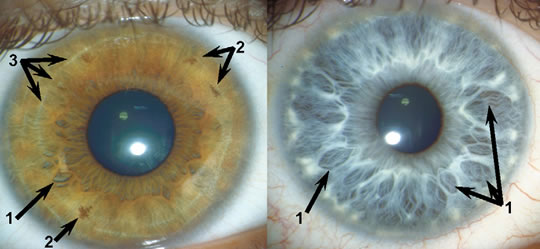
If you look closely at the coloured part of my eye, the iris, you might even get some clues as to my personality (Larsson et al., 2007).


Look closely for 'crypts' in my eyes (lines going away from the iris, labelled 1 above) and this suggests I'm a warm, tender-minded person. If you see furrows (labelled 3 above), then, watch out, I'm impulsive.

It seems that the same gene, Pax6, which affects part of the brain associated with approach-related behaviours (the left anterior cingulate cortex, if you really want to know) also induces tissue deficiencies in the iris.

Too small to see?


As you'll have noticed, the same pupil response can mean different things, although generally when the pupils dilate it sends a positive message and when they constrict it's a negative one. But exactly what it means depends on the situation (and whether someone has turned on a light).
This is all good fun to know, but can we really detect these tiny changes in people's p
upil size?
According to an fMRI imaging study, change in pupil size may be difficult for us to notice consciously, but we do seem to pick up on these very small changes unconsciously (Demos et al., 2008).

So changes in pupil size may be experienced, along with other verbal and nonverbal signals, as a gut instinct to either approach someone or run like hell.

Whether or not the eyes are windows to the soul, the pupils are certainly windows to the mind.

Image credits: maryaben & Larsson et al. (2007)


Friday, 16 December 2011

8 Psychological Keys to Spending Wisely

Post image for 8 Psychological Keys to Spending Wisely
In these economic times we could all use a little advice on how to spend our money wisely.
Help comes from a new survey of research on money and happiness gloriously titled 'If Money Doesn't Make You Happy Then You Probably Aren't Spending It Right' (Dunn et al., 2011).


They are trying to explain this paradox:

"Wealthy people don't just have better toys; they have better nutrition and better medical care, more free time and more meaningful labor—more of just about every ingredient in the recipe for a happy life. And yet, they aren’t that much happier than those who have less. If money can buy happiness, then why doesn't it?"

Their answer is that we tend not to maximise our money because the human mind is surprisingly poor at working out what will make it happy. The conclusions they reach aren't just useful for wealthy people, they can help all of us.

Here are the 8 pieces of advice:

  1. Why Many Small Pleasures Beat Fewer Larger Ones
  2. The Dangers of Comparison Shopping
  3. Why Spending Money on Others Promotes Your Happiness
  4. Buy More Experiences and Less Stuff
  5. Buy Less Insurance
  6. How to Get More Pleasure from Your Money
  7. The Impressive Power of a Stranger's Advice
  8. How to Dodge Buyer’s Remorse

Image credit: iChaz


Wednesday, 14 December 2011

How to Cope with Rejection at Work


I have a family member who is always clashing with her boss. I wonder if part of the problem is that she takes professional criticism personally. Over Thanksgiving one year, she explained to me that she is rejection sensitive, meaning that she’s attuned to any cue that she is being rebuffed, and has the tendency to react strongly to even the most minor rejection by another person.


Co-workers are like family – but not in a good way


Experts always talk about how to deal with rejection when you’re looking for a job, but they forget the fact that even when you already have a job, rejection can be toxic. The workplace is the environment where you spend most of your waking hours, and yet the people with whom you share the space didn’t choose to be in such close proximity. They may be very different from you, and they may not think you are the greatest thing since the iPad. While some degree of conflict is perfectly normal, for the rejection sensitive, a workplace can be minefield of hurt feelings.


Pick your poison – manager or co-worker rejection


The chief culprit is usually the manager. After all, your manager is charged by giving you constructive criticism and commenting positively — or negatively — on your performance. In an ideal world, she would always do so in a highly professional manner, but since it’s not an ideal world and we are all human beings, sometimes she will be harsh or tactless, or won’t think about how her words are coming across.
Co-workers too may not meet our expectations of them as supportive, collaborative friends. A co-worker who ignores you, makes a snide comment about your appearance or behavior, or chooses to go to lunch with someone else may send the rejection sensitive into a tailspin. Suddenly, it can feel like the entire office is operating against you, and you get angry and your opinion of your work sours. This can be dangerous, because if you lash out at work, your reputation and even your job itself may be in jeopardy. Here are a few helpful ways for coping with rejection at work:


Step away:  When someone hurts your feelings, excuse yourself from the situation and go to a private place. Relax and breathe deeply, and return to your office. Try not to see the person again until you’ve calmed down and gained some perspective.Remind yourself about who you’re dealing with:  Managers and co-workers are often assembled at random, and there’s no way you’re going to get along with everyone all the time. This person is not your best friend or a member of your immediate family, so he’s not worth reacting emotionally over.


Be objective about the rejection:  Think through the circumstances leading up to the rejection. Could you have done anything to cause the situation, or did it seemingly come out of nowhere? Is it possible that the other person didn’t mean to reject you at all, or has a completely different perspective on the issue? If your emotions are clouding your judgment, discuss what happened with a mentor or friend whose opinion you trust and value.


Try to let negative feelings go: The rejection sensitive person frequently finds herself the victim of a self-fulfilling prophesy. She feels rejected, and so she adopts an attitude of blame and behaves in a hostile manner toward others, which leads them to further reject her. For this reason, you should acknowledge your feelings of sadness, frustration, and betrayal, and then move on. Remain approachable and friendly even if you feel differently.


Minimize future rejection:  In addition to maintaining a positive attitude, always aim to improve your reputation as a professional, competent, can-do employee.  If someone you trust makes a suggestion, implement it, and if you see a way to go above and beyond the call of duty, do it.  This won’t erase rejection from your life, but it will at least lessen the number of legitimate causes.
Rejection is an unfortunate aspect of daily work life, but like most things, it’s within your power to either sail through it easily, or with a lot of bumps.  Hopefully, by following these tips, you will be able to weather the storms more successfully.


(Photo credit: Bullying in the workplace and office
from Shutterstock)

How to Cope with Rejection at Work

“A Closer Look at Dishonesty”


What they don't know...

So, what are your thoughts on honesty? Do you fib? Often? Do you have honesty rules? If so, where did those rules come from?

Experience? Parents? Church? Your inner voice?


Do you think that sometimes dishonesty is the right thing? The best option in some situations? Could there be a time when dishonesty is the best policy?


Oh, the questions…

We all know that honesty can be painful — and unpopular. It can also be liberating — and rewarding. We know it will end some relationships — and repair others. Sometimes, it shuts doors — and sometimes, it opens them.

Some people want to hear the truth. Some don’t.

Some say they do…but really they don’t.

Lying About Lying

Like it or not, want it or not, lying is an ever-present reality of the world we live in.
Kids do it — and so do grown-ups. Governments do it to protect you and me. Apparently.
(Or maybe they do it to protect themselves.)


Who else does it?
  • Businesses
  • Wives
  • Husbands
  • Bosses
  • Staff
  • Managers
  • Leaders

Even those who stand in front of their congregations on the weekend do it.


Not surprisingly, we usually lie about our lying too. And when we do get busted, we inform the Honesty Police that our moral misdemeanor was in fact a ‘white lie’; a well-meaning deception. And, as we all know, white lies are okay.


Degrees of Honesty

Some people talk about the notion of ‘complete’ honesty, but is there any other kind? Surely, if it’s not complete honesty, then it’s dishonesty…right?


“If it ain’t true, then it’s a lie.” Isn’t it? There’s no such thing as ‘telling a bit of a lie’ is there? A ‘half-truth’ (a term we use often) is simply a euphemism for dishonesty, isn’t it? And I guess ‘bending the truth’ sounds more honorable than ‘lying my arse off’. And finally, let’s not forget the very manly art of exaggeration; one of the more socially acceptable forms of lying.


Wow, it’s hard to be honest about our dishonesty isn’t it?


After all, nobody wants to wear the ‘liar’ label. We tend to get a little self-righteous and defensive when it comes to our ‘bending of the truth’ don’t we? Someone recently said to me, “Oh, yes Craig — but there’s lying and there’s lying.” The implication being that there’s acceptable and unacceptable lying.
Interesting.


Selfless and selfish lying, perhaps? Okay, who decides which is which?


The same person told me that she only lies when “she has to” and that “sometimes lying is the kind thing to do”. Can’t say that I totally disagree with her.


So many great questions. But are there any universal answers?


Am Not! You Are!

When questioned, most of us say we’re honest people. It’s what we do. It’s our default setting.
But it’s not true; most of us lie regularly.


Of course, we might lie for ‘noble’ reasons. Like to avoid hurting someone’s feelings. Or to avoid sharing some personal information. Or to avoid a pointless argument or a potentially volatile situation. But surely that kind of dishonesty is okay.


Wouldn’t honesty be an illogical choice in some situations? Which would make the occasional fib totally acceptable when there’s a good reason. Wouldn’t it? Having said that, who decides what a ‘good’ reason is?


Hmm…more questions.


One study revealed that the average person lies three times in a typical ten minute conversation. Notice I didn’t say “the average pathological liar lies three times”. No…I said “the average person”. Clearly, you and

I are not average.


I lie much more.


So, what are your thoughts on honesty? Come on…be honest.


(Photo credit: Businessman Crossing Fingers
via Shutterstock)

Please Share...